Doing the Blue Cave Without a Tour
On a blue-flag day Cape Maeda costs about ¥500–1,000: parking, a two-minute shower, your own gear. The rules, the fees, and the safety data.
Yes, on a blue-flag day — and this page is deliberately not going to talk you out of it. Cape Maeda is a public facility with public stairs, the fees are trivial, and people do it unaccompanied every day the flag is blue.
Two conditions attach, and neither is negotiable.
The flag has to be blue. On yellow, the management office restricts the water to people with a diving company or instructor, and this page does not apply to your day. On red, nobody uses the stairs. How to read the flag before you drive is here.
A life jacket or buoyancy aid is mandatory for snorkellers. The management office’s Japanese homepage words it as an instruction, not a suggestion. One operator here cites Okinawa Prefectural Public Safety Commission regulations as the reason, on each of its three listings.
What it actually costs
Published by the Cape Maeda Management Office, checked September 2026:
| Item | Price |
|---|---|
| Parking, car or motorcycle | ¥100 first hour, then ¥100 per hour |
| Parking, microbus | ¥300 first hour, then ¥150/hr |
| Parking, large bus | ¥500 first hour, then ¥200/hr |
| Hot shower | ¥200 for 2 minutes |
| Hair dryer | ¥100 for 4 min 30 sec |
| Coin locker | ¥100 |
| Toilets, changing rooms | Free |
A realistic three-to-four-hour visit lands around ¥500–1,000 — ¥300–400 of parking, plus showers. Two minutes is short, and people with long hair routinely pay twice; a Japanese dive-shop guide puts the typical spend for women at ¥400–600 on showers alone.
Bring coins and ¥1,000 notes. The machines take nothing larger — not ¥2,000, ¥5,000 or ¥10,000. There are 180 car spaces, five for large vehicles, four accessible.
Two things that catch people: shampoo and body soap are banned in the showers, for environmental reasons, and the car park fills by about 08:00 in high season and stays full until mid-afternoon, with 30-to-60-minute waits. Parking on the road nearby is a stated village problem; the office asks people to wait instead.
What you are not allowed to do
The office publishes a list of twelve prohibitions in English. The ones people trip over:
- Cliff-diving near the cape or inside the Blue Cave
- Swimming in severe weather or dangerous sea conditions
- Spearfishing, including a Hawaiian sling
- Carrying an inflatable boat or kayak down the stairs
- Private water tanks for rinsing in the car park
- Barbecues; beach parasols and chairs in the car park
- Double-edged blades of 5.5 cm or more
No certification is required to snorkel. A trial dive needs no C-card but must be supervised throughout by an instructor; fun diving needs a C-card.
The part that deserves a straight answer
Cape Maeda is named on the Japan Coast Guard 11th Regional Headquarters’ official Marine Leisure Personal Accident Hotspot Map for Okinawa Main Island, covering 2016–2025, alongside Gorilla Chop, Bise and others. That is a Coast Guard publication, not a newspaper’s characterisation. We are not quoting a per-site casualty figure from it, because the location labels and the numbers sit in separate layers of that PDF and we could not match them reliably.
The region-wide figures are clear enough on their own. Across 2021–2025, Okinawa recorded 469 marine-leisure accident victims and 129 dead or missing. Snorkelling is the deadliest activity in that data — 154 victims, 63 deaths, about half of all fatalities, ahead of both diving and swimming. 87% of those who died while snorkelling or swimming were not wearing a life jacket. Seventy per cent of deaths were aged 50 or over. 2025 was the worst year since records began in 2001.
The management office is equally direct about its own position: Cape Maeda is not a swimming beach. No lifeguards. No stinger nets. Rapid tidal movement, described as dangerous. No responsibility accepted for anything that happens in the water. There is a life-buoy and an AED at the office.
What the pattern in the data is not is reckless people in bad conditions. Reported Blue Cave fatalities include deaths in calm, clear water, and the dead skew heavily older — which points at medical events rather than heroics. So the Coast Guard’s own two-line advice is the right thing to repeat, and it is not a sales pitch: wear the life jacket, and go with someone who knows that water.
Going alone is legal and normal on a blue flag. It also means there is nobody whose job is to notice you.
Jellyfish, water temperature and the calendar
The Okinawa Prefecture habu jellyfish advisory runs 1 June to 30 September in 2026. In 2025 the prefecture logged 199 marine sting and bite cases, 81 of them habu. Peak is late July to mid-August. There are no stinger nets here, because those go up at designated swimming beaches. The prefecture advises covering exposed skin and carrying vinegar — which is the real reason to wear a rash guard in August, not the sun.
Water runs about 20°C at its February coldest and 28–30°C at its August warmest. These are dive-operator figures, agreed closely across shops, rather than Meteorological Agency readings — the JMA publishes regional sea-surface averages, not a nearshore monthly table for Onna. A 3 mm suit is enough July to September; 5 mm with a hooded vest in the depths of winter.
Typhoons: on JMA 1991–2020 normals, 7.7 approach Okinawa a year, peaking in August (2.2) and September (1.9), with a flat zero recorded in January, February and March across the entire 30-year period.
Sunscreen, coral and the thing we could not confirm
Onna Village adopted Green Fins in April 2020 — the UNEP and Reef-World standard, the first adoption in Japan and the world’s first led by a municipality. The rules that apply to you personally: don’t touch or stand on coral; don’t wear gloves, because they make you confident enough to touch things; don’t feed the fish; take your rubbish home.
On sunscreen: bans on oxybenzone and octinoxate exist in Hawaii, Palau, Key West, Bonaire and Thai national parks. We found no such law in Japan or Okinawa Prefecture — and we want to be precise that this is an absence of evidence rather than a confirmed absence of a law. Local guidance exists without it; OIST, which sits in Onna Village, advises against chemical sunscreens containing oxybenzone. A mineral sunscreen, or simply covering up with a rash guard so you apply less of anything, handles both this and the jellyfish.
Getting there without a car
You will want a car. Cape Maeda is about 50–54 km and an hour from Naha Airport by expressway, toll around ¥610 with ETC; a taxi is roughly ¥10,000.
Bus route 120 from Naha Airport reaches the Kurawa stop in about 90 minutes, and the management office puts the walk from there at about 20 minutes, uphill. Published fares range ¥1,200 to ¥1,360 across sources and all of them are stale. A Japanese travel guide’s verdict is blunter than we would put it: because of the walk, going by bus is not recommended. There is no railway on this coast.
If you have no car, the cheapest sensible route into the water is a trip that includes hotel pickup — which is a transport argument, not a snorkelling one, and worth separating from everything else on this site.
Just go
Life jacket, coins for the machines, and an early start for the car park. Nothing on this page is trying to sell you a guide for a blue-flag morning.
Check the flag first →Book a shop
Hotel pickup solves the transport and the car park at once, and on a yellow flag a shop is the only lawful way into the water. Prefer one that publishes what it does when the cave shuts.
See what's bookable →Fees and rules on this page are as published by the Cape Maeda Management Office and Okinawa Prefecture, checked September 2026. The office’s own opening hours appear three different ways across its pages — phone 098-982-5339 rather than trusting any single version.
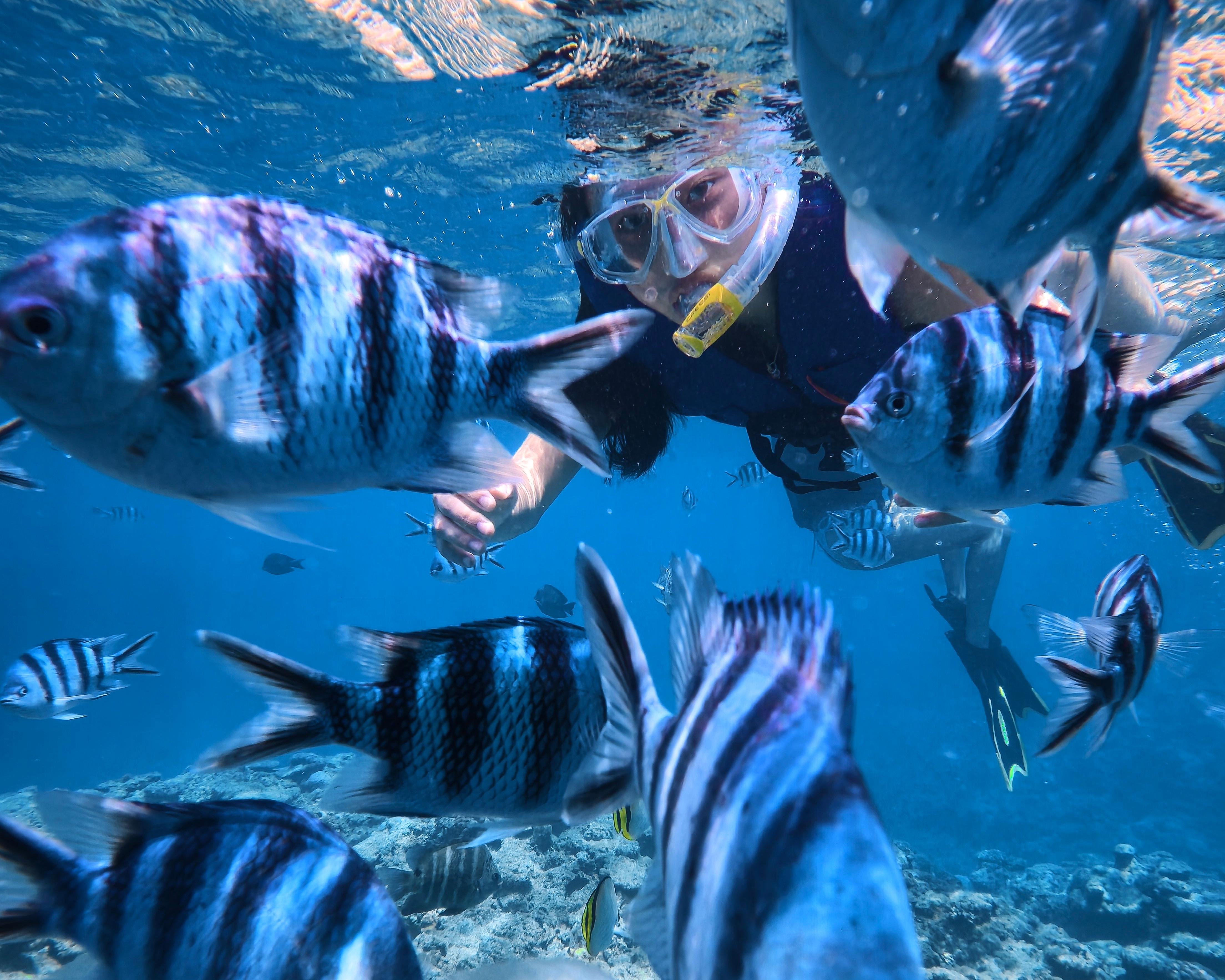
The Most-Reviewed Blue Cave Trip on the Shelf
A private guide rather than a group, and the clearest closure wording on the shelf: an alternative beach offered, and a full refund if you would rather not take it. Rated 4.9/5 by 156 verified guests — more than twice the review count of any other Blue Cave trip here — from about $45, with free cancellation.
Check Availability & Book